
Microsoft AI Models Compete With GPT and Claude: MAI Code 2 for Product Teams
At Ignite 2026 Microsoft positioned MAI Code 2 near GPT-6.1 Sol and Claude Opus 5.5 on everyday coding at a fraction of the price. Here is what that means if you are building your next product on Microsoft AI models.
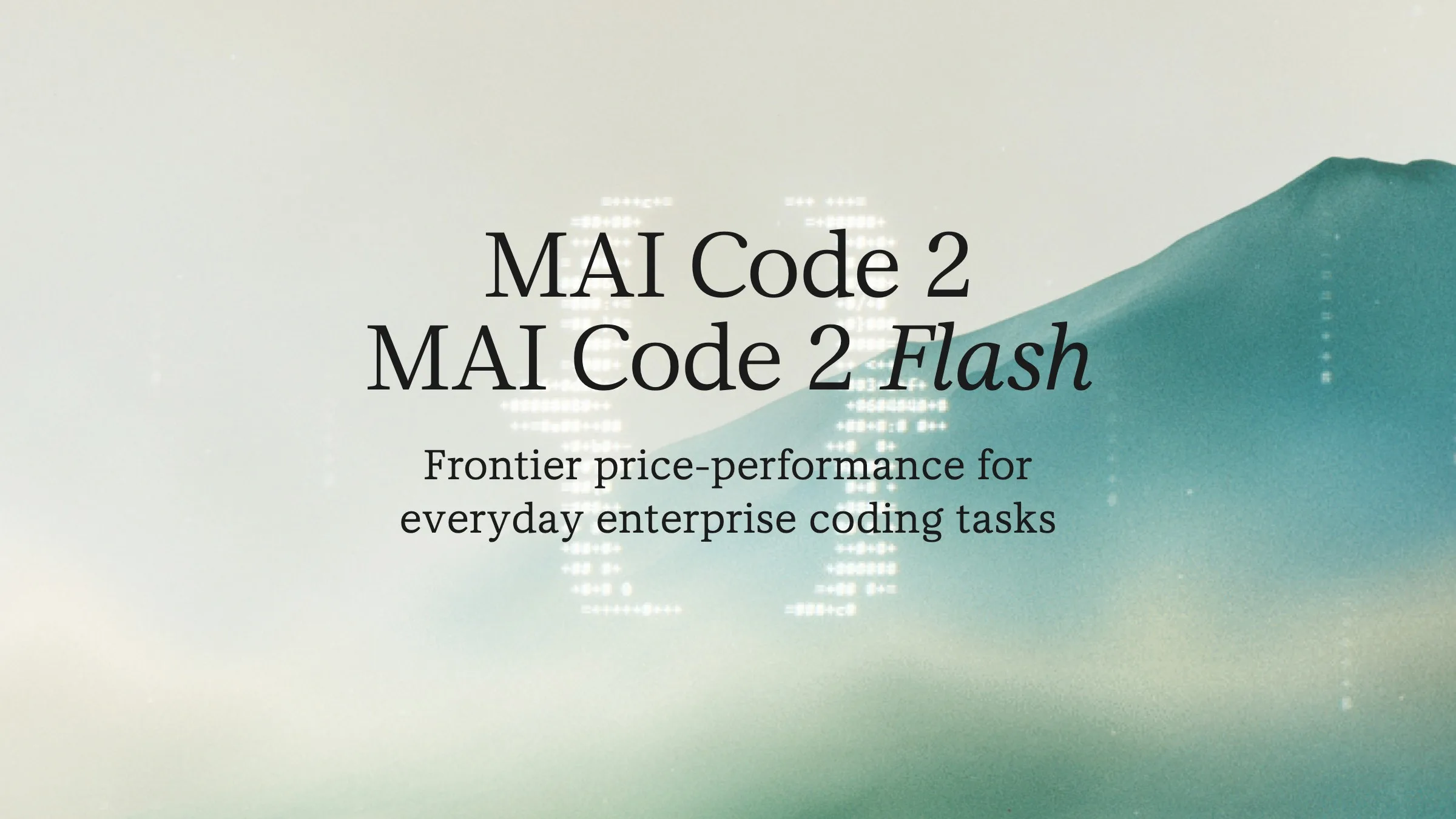
Microsoft AI models are closing the practical gap with leading GPT and Claude coding models by competing on price-performance for everyday software work, not on every frontier science task. At Microsoft Ignite 2026, MAI Code 2 and Code 2 Flash were framed as affordable coding agents you can run continuously in production products.
Facts below follow Microsoft AI’s MAI Code 2 announcement and the Ignite 2026 models post (17 November 2026), plus Mustafa Suleyman’s LinkedIn summary of the same release. Benchmarks and prices are Microsoft-reported; promotional list prices and selected eval suites apply. Confirm live rates and access in GitHub Copilot and Microsoft Foundry before you lock a product budget.
Why is Microsoft AI trending against GPT and Claude right now?
Token spend for agents that run all day is the constraint founders feel. Absolute frontier models find the hardest bugs, but they are too expensive to leave on for every routine fix. Microsoft’s MAI pitch is explicit: specialize for the coding work GitHub Copilot already sees, and stop making every bug fix subsidize science-lab capabilities.
That message lands with product teams searching for Microsoft AI models, MAI Code 2, Microsoft Foundry pricing, and “cheaper alternative to Claude Opus for coding agents.” The trend is not “one model to rule every domain.” It is multi-model stacks where everyday workers stay cheap and frontier calls stay rare.
Axios coverage of Ignite also notes Microsoft’s strategy of specialized models that rival OpenAI and Anthropic offerings on selected workloads at a fraction of the cost, while Microsoft continues work toward broader frontier systems. For builders, the near-term decision is whether MAI Code 2 wins your mergeable coding jobs at a cost you can scale.
What did Microsoft claim for MAI Code 2 versus GPT and Claude?
On a four-benchmark average aimed at everyday enterprise coding (DeepSWE 1.1, Terminal Bench 2.1, SWE-Atlas, FrontierCode v1.1), Microsoft says MAI Code 2 delivers 98% of GPT-6.1 Sol performance at about 40% of the cost, and 96% of Claude Opus 5.5 performance at about 5% of the cost. Models were run at max reasoning effort in Microsoft’s published methodology.
In blind frontend and visual coding evaluations (UI, games, dashboards, 3D, SVG), developers preferred MAI Code 2 over GPT-6 Sol 64% of the time across aesthetics and functionality, per Microsoft’s annotator study. MAI Code 2 Flash is positioned for high-volume explanations, targeted edits, and routine fixes, with Microsoft claiming comparable quality to GPT-6 Luna and Claude Haiku 5.5 at roughly 65% and 20% of those prices on a three-benchmark everyday suite.
Microsoft is clear about the trade-off: these models are not yet tuned for fundamental science research or very long-horizon agentic work. If your product’s core job is that frontier band, keep a GPT, Claude, or Gemini 4 Carbon-class planner and use MAI for volume. Read footnotes on promotional pricing; some published cost ratios use a 50% promotional list price for MAI Code 2 and Flash.
How does the wider Microsoft AI Ignite lineup support a product stack?
Ignite also shipped specialized peers around Code 2. MAI Cyber 2 Flash targets 24/7 defense workloads with Microsoft claiming better CyberGym-E2E quality than GPT-6 Astra at under 2% of the cost per task. MAI Image 2.7 is claimed #1 on Artificial Analysis image editing versus GPT Image 2.6 Sunburst (max) at about one-fifth the price. MAI Realtime 1 is a live speech-to-speech model Microsoft says outperforms GPT-Realtime 2.1, starting at $0.01 per audio minute in their post.
Decision 1.1 is Microsoft’s routing and decision layer: Artificial Analysis Decision Index leadership in Microsoft’s telling, 50x faster and 79x cheaper than GPT-6.1 Sol for decision-style work, already used by thousands of customers. That matters for product architecture. Route cheap when the job is routine; escalate only when the harness fails.
MAI Work Flash variants also power internal Microsoft 365 and FabricIQ scenarios in Microsoft’s offline evals. For an independent product, treat those as proof that Microsoft will keep investing in MAI inside Copilot surfaces, not as a free license for your app. Your agent still needs tools, identity, and evaluation on your data.
Who should build their next product with Microsoft AI models?
Founders shipping coding agents, internal developer platforms, or Copilot-adjacent workflows on Azure are the clearest fit. If your users already live in GitHub, VS Code, Microsoft 365, or Foundry, MAI Code 2 reduces vendor sprawl and often lands inside procurement conversations that already trust Microsoft.
Teams with high agent volume win when 80% of steps are everyday edits and reviews. MAI Code 2 Flash as a worker, Decision 1.1 or a thin router for escalation, and a frontier model for rare hard plans is a pattern finance can understand. Cyber-heavy products should pilot MAI Cyber 2 Flash on defender jobs that must run continuously.
Weak fits today: products whose differentiator is long-horizon research agents, novel scientific reasoning, or workloads Microsoft explicitly excluded from Code 2 tuning. Also weak: teams with no evaluation harness. Price-performance claims collapse if you cannot measure mergeable diffs on your repos.
| Buyer situation | First Microsoft AI trial | Why | Watch-out |
|---|---|---|---|
| Coding agent or Copilot extension | MAI Code 2 in GitHub Copilot | Near-frontier everyday coding at lower unit cost | Promo pricing end date; prove on your repos |
| High-volume PR comments and small fixes | MAI Code 2 Flash | Fast loops closer to Luna/Haiku economics | Quality cliffs on multi-file redesigns |
| Azure product with Entra and Foundry | Code 2 Flash Foundry preview + hosted agents | Same estate as identity and egress | Preview access and regional quotas |
| Security monitoring agent | MAI Cyber 2 Flash | Built for continuous defense cost profile | Scope, audit, and human approval still required |
| Voice or image product surfaces | MAI Realtime 1 / Image 2.7 | Specialized price claims vs OpenAI peers | Separate harness from coding agent evals |
How should you pilot MAI Code 2 before changing production?
Freeze a harness of 20–40 real tasks from your backlog: multi-file features, deep bugs, UI polish, and routine one-liners. Run the same prompts under your current model and MAI Code 2. Score mergeability, human edit minutes, tokens, and dollars per successful completion. Prefer maintainer judgment over public index screenshots.
Start in GitHub Copilot where Microsoft says Code 2 is available today, and request Foundry limited-access preview for Code 2 Flash if your product API path needs Foundry. Microsoft also signaled upcoming availability on OpenRouter, Vercel, Hermes, OpenCode, and Kilo; treat those as distribution channels, not as architecture.
If you customize, Microsoft’s Custom Models and newer Licensed Weights story is aimed at enterprises that refuse to pour proprietary IQ into a shared frontier weight they cannot control. AT&T’s 5G analytics custom MAI example in the Ignite post is a reference pattern, not a template. Custom weights only help after the job and data contract are clear.
What mistakes waste a Microsoft AI model migration?
Swapping every chat and agent surface to MAI Code 2 because of a headline ratio. Interactive support chat, overnight research, and PR agents have different latency and risk budgets. Flag them separately.
Ignoring promotional price footnotes when you pitch finance. If your model uses a 50% promo in the published chart, model the post-promo bill in week one. Escalating to Opus or Sol on every failure without a router. You recreate the cost problem MAI was meant to solve.
Treating Microsoft’s “not tuned for long-horizon agents” caveat as marketing fluff. If your roadmap is multi-hour autonomous coding with weak checkpoints, Code 2 alone will not save you. Pair it with durable job state and human gates, or keep a stronger planner. Architecture notes for Azure agents after Ignite live in hire .NET AI agent developers and Foundry hosted agents.
How does ImadDhin help teams build on Microsoft AI models?
ImadDhin is a founder-led AI product engineering studio. We help teams that want to build the next product with Microsoft AI models choose the right MAI tier, wire Foundry or Copilot paths, and ship agents that stay measurable after launch—on Azure, .NET, and mixed stacks when needed.
A typical engagement starts with your job list and current model bill, not with a model logo. We design the evaluation harness, confirmation gates, and routing so MAI Code 2 or Flash carries volume while frontier calls stay scarce. When the product needs hosted agents, egress, or Durable Agent Framework, we implement those paths rather than stopping at a Copilot demo.
If you are comparing Microsoft AI against Gemini 4 or other stacks for the same product, bring both harnesses. We will not force a vendor. We will force a measured win on your traces. For agent practice framing see AI agents; for product phases see AI product development.
Looking to build your next coding agent, Azure product, or Copilot-connected workflow on Microsoft AI models? Start a brief on Start project or book Let’s Meet. Bring three failed jobs and your monthly token spend so the first pilot has a clear success line.
Frequently asked questions
Is MAI Code 2 better than GPT-6.1 Sol or Claude Opus 5.5?
Microsoft reports near-parity on a selected everyday coding benchmark average at much lower published cost, not a universal win on every frontier task. Run your own harness before you switch production.
Where can I try MAI Code 2 and Code 2 Flash?
Microsoft says both are available in GitHub Copilot, with Code 2 Flash in limited-access preview in Microsoft Foundry, and further channel rollouts planned.
Should every product migrate to Microsoft AI models?
No. Migrate when everyday coding or specialized MAI workloads dominate your volume and Azure or Copilot is already strategic. Keep frontier models for jobs Microsoft says Code 2 is not tuned for.
How do promotional prices affect the MAI Code 2 cost claims?
Microsoft’s footnotes note that some MAI Code 2 and Flash cost figures use a 50% promotional price. Budget the post-promo rate and re-check finance after the promo window.
Can ImadDhin build a product on Microsoft AI models?
Yes. We scope agents and apps on MAI, Foundry, and Azure with evaluation, routing, and production controls. Use Start project or Let’s Meet to begin from your real workflows.
Build your next product with Microsoft AI models.
Brief the agent or app you want on MAI Code 2, Foundry, or Azure.
Start projectCompare Microsoft AI models to your current GPT or Claude stack with a pilot plan.
Let’s MeetHow ImadDhin ships on .NET, Azure, and Microsoft AI.
Microsoft Technologies