

Gemini 4 Models Rise Again: Neon, Hydrogen, Carbon in Google AI Studio
Google’s Gemini 4 lineup (Neon, Hydrogen, Carbon) is live in AI Studio with a shared 1M context window. Here is how to pick a model and start building agents and apps now.
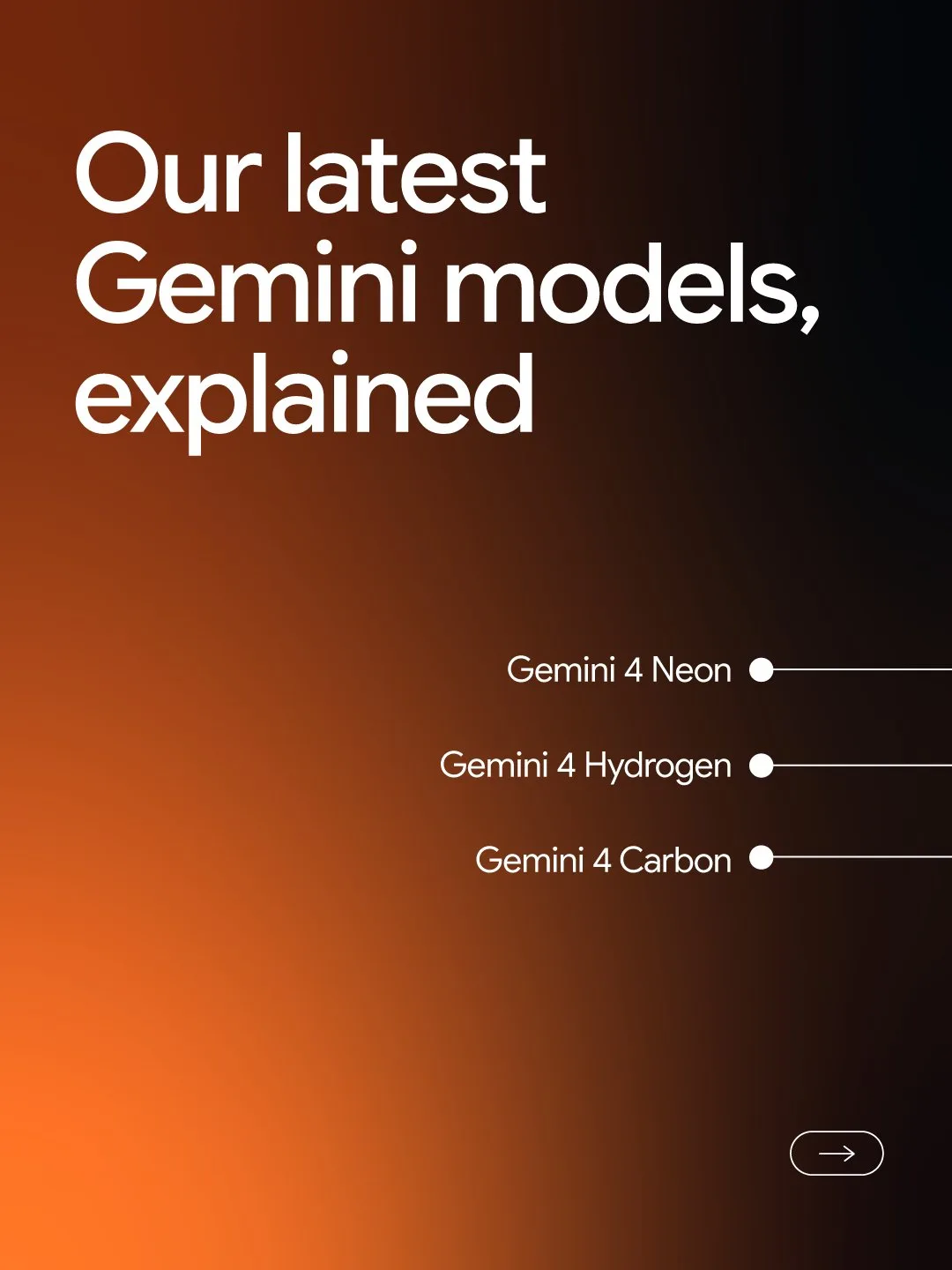
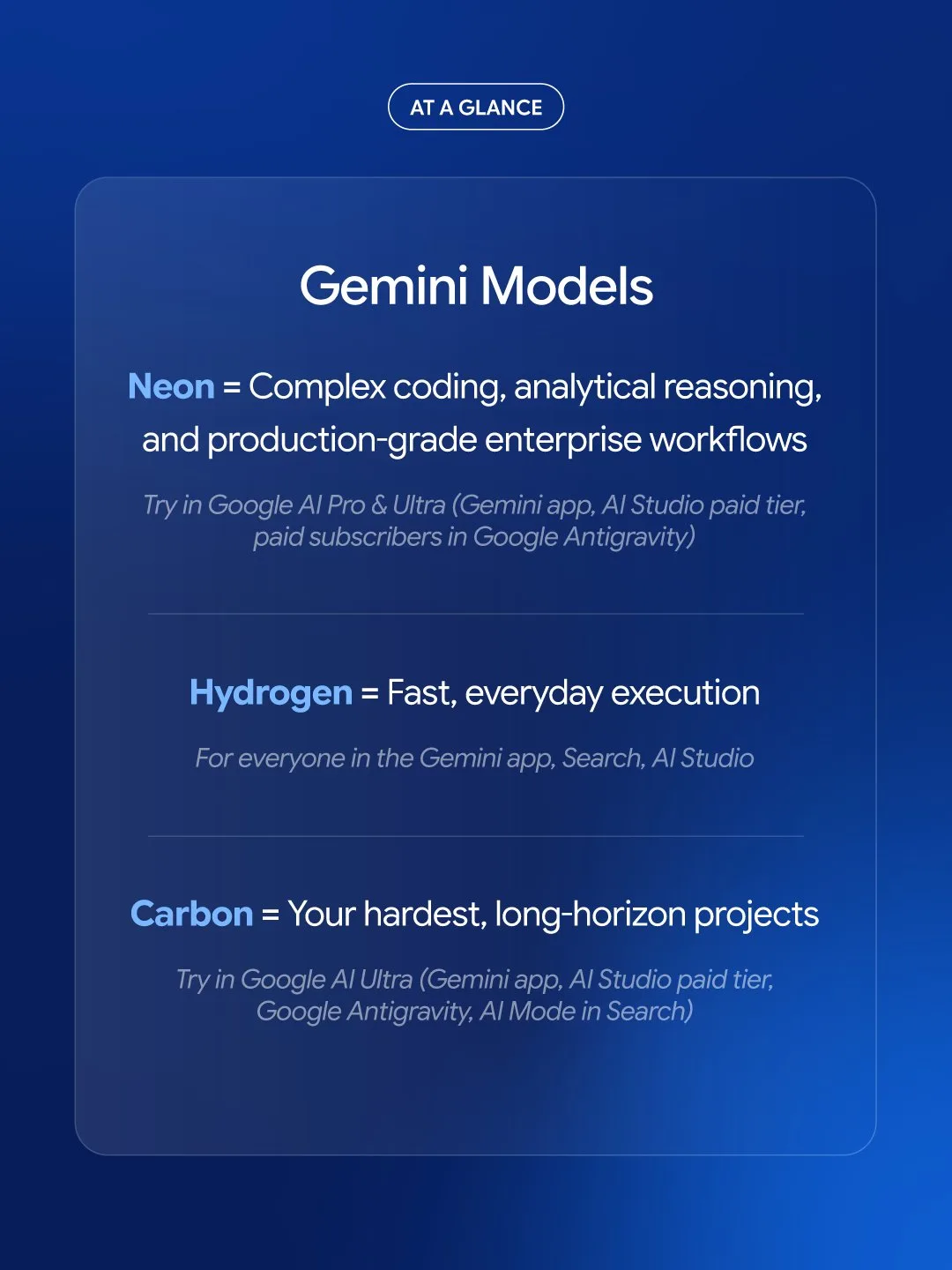
Gemini 4 models are Google’s November 2026 comeback for coding, agents, and multimodal work: Neon for deep reasoning at production speed, Hydrogen for everyday agent loops, and Carbon for the hardest long-horizon jobs. All three ship with a unified 1M-token context window through Google AI Studio and the Gemini API.
This guide follows Google’s live docs at AI Studio Docs, Latest Gemini models, and the Models catalog. Pricing and channel details are current as of late November 2026. Confirm model ids and rates in your project console before budgeting.
Why are Gemini 4 models trending for builders right now?
Three releases landed within days of each other: Carbon on November 10, Hydrogen on November 12, and Neon on November 18, 2026 (changelog). That cadence matters more than a single launch post. Teams can finally map planner, worker, and hard-reasoning roles to named Gemini 4 endpoints instead of stretching one Flash model across every job.
The other trend is the Interactions API: Google’s default interface for models and agents since June 2026. New agent features, background execution, and managed sandboxes land there first. If you are starting a project in Google AI Studio today, Interactions is the path that keeps you on the frontier without rewriting next quarter.
Search demand clusters around Gemini 4 Neon, Gemini 4 Hydrogen, Gemini 4 Carbon, Google AI Studio agents, and “which Gemini model for coding.” Founders also ask how Antigravity and Managed Agents fit. Those queries all resolve to the same production question: which model finishes the job at a cost you can defend.
What is Gemini 4 Neon best for?
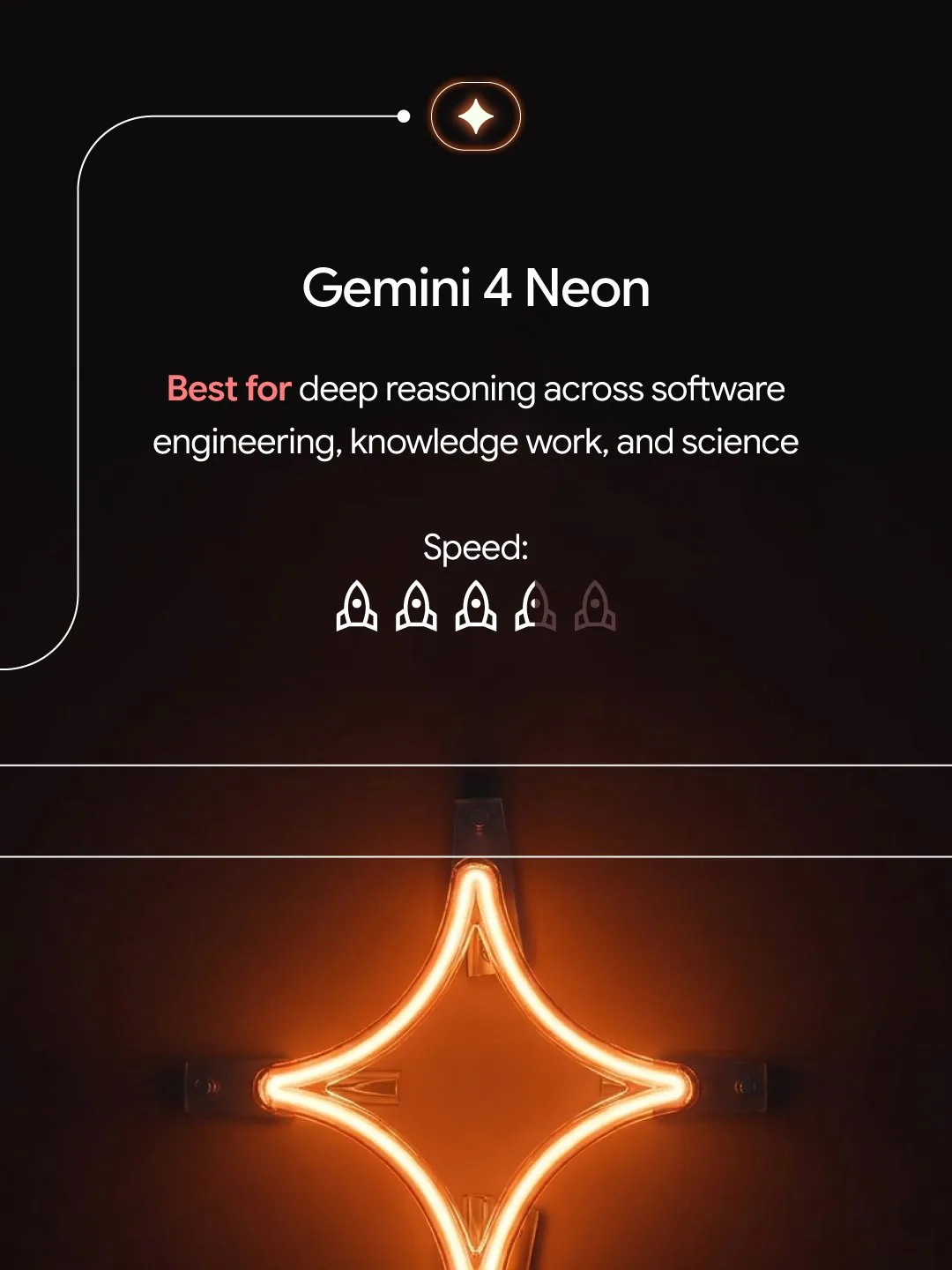
Gemini 4 Neon (`gemini-4-neon`) is positioned for frontier-level intelligence with fast end-to-end completion across complex software engineering, knowledge work, and science workflows. Google documents a 1M unified context window, default max output of 64K tokens, and long decode up to 1M tokens (Neon model page).
Paid pricing is $3.00 per 1M input tokens and $15.00 per 1M output tokens, with thinking levels through `xhigh`. Neon is not on the free tier. Product messaging highlights deep reasoning across software engineering and science with a moderate speed profile. In Antigravity-style stacks, Neon can also act as a high-judgment orchestrator directing faster Hydrogen workers.
Use Neon when your agent must finish multi-step coding or research jobs with tools, long context, and mid-run corrections. Do not use it as the default for high-volume chat or cheap classification. For a pilot checklist aimed at production agents, see Gemini 4 Neon for production agents.
What is Gemini 4 Hydrogen best for?
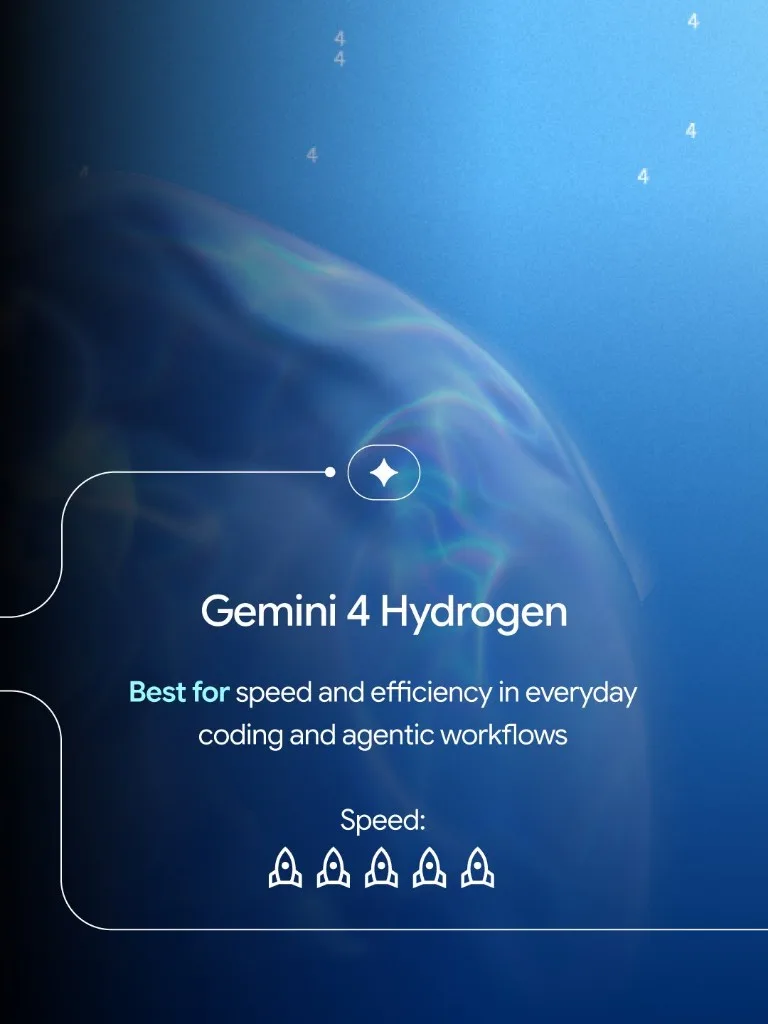
Gemini 4 Hydrogen (`gemini-4-hydrogen`) brings cutting-edge intelligence with speed and efficiency for everyday coding and agentic workflows. It is Google’s recommended default general-purpose Gemini 4 model on the latest models page, with the same 1M context and long-decode envelope as Neon and Carbon.
Paid pricing is $1.50 per 1M input and $7.50 per 1M output. Hydrogen is available on the free tier in Google AI Studio for many developer surfaces, and it powers the default Antigravity managed agent path. Thinking levels include `low`, `medium`, default `high`, and `xhigh`.
Hydrogen is the right first model when you are building an agent that loops tools often: file edits, search, code execution, and short verification steps. Keep expensive Neon or Carbon calls for planning or hard failures. Routing details and Orchestrator patterns are covered in Gemini 4 Hydrogen and Orchestrator.
What is Gemini 4 Carbon best for?
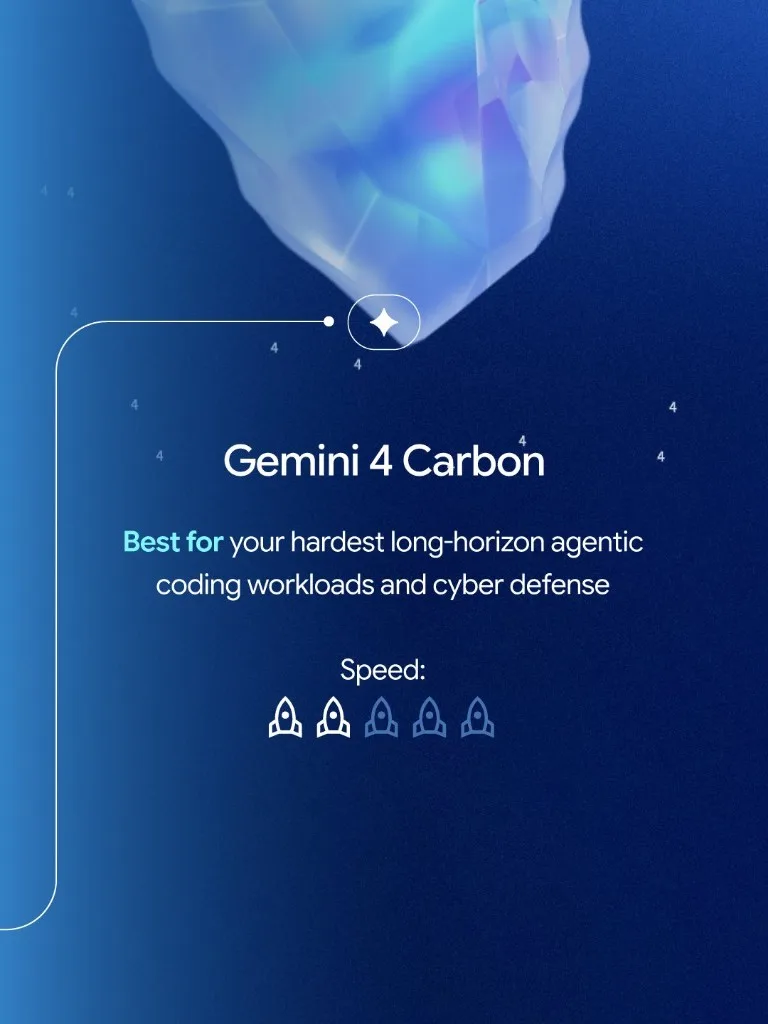
Gemini 4 Carbon (`gemini-4-carbon`) is Google’s most capable reasoning model for complex software engineering, multimodal knowledge work, scientific reasoning, cybersecurity defense, and autonomous multi-step agents (Carbon model page). Speed is deliberate. The payoff is depth on long-horizon work.
Introductory paid pricing through November 30, 2026 is $2.00 per 1M input and $10.00 per 1M output, rising to $4.00 / $20.00 from December 1, 2026. Carbon is not on the free tier. Thinking levels are `low`, default `medium`, and `high` (no `xhigh` on Carbon’s published table).
Choose Carbon when the job is your hardest agentic coding workload, a security review that cannot invent findings, or a long-horizon plan that must stay coherent across many tool steps. Budget wall time and dollars separately from Hydrogen workers. Carbon is a scalpel, not a daily chat model.
How do Neon, Hydrogen, and Carbon compare for agents and apps?
All three accept text, image, audio, video, and PDF. All support Google Search grounding, code execution, function calling, computer use, and structured outputs per Google’s latest-model notes. The difference is speed, price, and how much reasoning you buy per turn.
| Model | Model id | Best for | Speed | Paid price (1M in/out) | Where to try |
|---|---|---|---|---|---|
| Gemini 4 Neon | `gemini-4-neon` | Complex coding, analytical reasoning, production enterprise workflows | Moderate | $3 / $15 | Google AI Pro & Ultra, AI Studio paid, Antigravity paid |
| Gemini 4 Hydrogen | `gemini-4-hydrogen` | Fast everyday coding and agentic workflows | Fast | $1.50 / $7.50 (free tier available) | Gemini app, Search, AI Studio |
| Gemini 4 Carbon | `gemini-4-carbon` | Hardest long-horizon agentic coding and cyber defense | Deliberate | $2 / $10 intro thru Nov 30, then $4 / $20 | Google AI Ultra, AI Studio paid, Antigravity, AI Mode in Search |
Treat the table as a starting hypothesis. Your evaluation harness decides the winner on your traces. A marketplace agent, a FlutterFlow rescue, and a security audit will not share the same default. Write success criteria before you change the production model id.
How should you start a project in Google AI Studio with Gemini 4?
Open Google AI Studio and start on the Interactions API, not legacy `generateContent`. Google’s docs state Interactions is the recommended interface for all new projects and the place where managed agents and background execution continue to expand (Interactions overview).
Pick Hydrogen first for a greenfield agent or app prototype. Prove the job, tools, and confirmations. Promote Neon when end-to-end completion quality is the bottleneck. Promote Carbon when long-horizon planning or cyber-grade reasoning is the bottleneck. Keep Flash-Lite or a cheap verifier only for high-volume sub-steps after the core path works.
Google also ships Managed Agents such as Antigravity (`antigravity-preview-09-2026`) for sandboxed code, files, and web work, plus Deep Research agents for multi-step research (Agents overview). Those are product accelerators. They are not a substitute for your auth, permissions, and audit trail when the agent writes to your systems.
If you need a founder-led build that ships past the Studio playground, start from AI agents and AI product development, then book Let’s Meet. The studio pattern is the same: one production job, bounded tools, measured model choice.
Which trends should product teams watch through early 2027?
Multi-model routing is normalizing. Planner models and worker models are no longer an advanced pattern; Google’s own Antigravity Orchestrator narrative assumes it. Log model id per step or you cannot debug cost or quality later.
Stateful Interactions with `previous_interaction_id` and `background=true` are replacing long client-held chat transcripts for agent runs. Design your product UI around typed steps (thought, tool call, output) so operators can see what the agent did. That observability is now a buyer expectation, not a nice-to-have.
Gemini 2.5 Pro and 2.5 Flash are on deprecation paths with automatic routing to newer Flash models from December 1, 2026. New work should not start on 2.5. Migrate strings early and re-run your harness. Staying on sunset models is a silent production risk.
Cost pressure will push teams toward Hydrogen-heavy architectures with Neon or Carbon on demand. Finance will ask for dollars per successful job, not tokens. Build that metric into the first sprint, or every model upgrade becomes a debate without evidence.
What mistakes block teams from shipping Gemini 4 agents?
They paste a Neon model id into every surface on day one. Latency and spend explode while chat quality barely moves. Separate interactive chat, worker agents, and overnight batch jobs behind flags.
They skip confirmations on writes. Consumer Gemini Tasks messaging still stresses confirm-before-buy patterns; production agents need the same gates for payments, outbound mail, and record changes. See Gemini Tasks confirmation patterns and human-in-the-loop agents.
They treat Google AI Studio demos as production architecture. Studio proves the model. Your app still needs identity, secrets outside the client, tool allowlists, and an evaluation harness. Model quality does not repair missing auth.
They ignore introductory Carbon pricing deadlines. If Carbon is in your plan, run the hard-job pilot before December 1, 2026 pricing steps up, or re-budget explicitly so finance is not surprised mid-quarter.
How does ImadDhin help you build on Gemini 4 and Google AI Studio?
ImadDhin is a founder-led AI product engineering studio. We design production agents and apps around real jobs: tools, permissions, evaluation, and a model mix you can operate. Gemini 4 Neon, Hydrogen, and Carbon are options inside that system, not the product itself.
Typical first week: freeze a harness of failing jobs, wire Interactions with Hydrogen workers, add confirmation gates on irreversible actions, then trial Neon or Carbon only on the stages that need them. That sequence keeps Google AI Studio experiments from becoming an unowned production bill.
If your current vibe-coded prototype needs rescue before a model upgrade, say so early. Prototype to Production comes before a frontier model swap when secrets, auth, or the critical path are still broken.
Bring your tool list, current model spend, and three failed agent jobs to Let’s Meet. We will map Neon, Hydrogen, and Carbon to stages you can measure, then scope the agent or app build that stays after launch.
Frequently asked questions
What are the Gemini 4 models available in Google AI Studio?
The core Gemini 4 reasoning lineup in late November 2026 is Gemini 4 Neon (`gemini-4-neon`), Gemini 4 Hydrogen (`gemini-4-hydrogen`), and Gemini 4 Carbon (`gemini-4-carbon`), plus Argon. Confirm live availability on Google’s latest models page.
Which Gemini 4 model should I start with for an agent?
Start with Gemini 4 Hydrogen for everyday coding and agent loops. Promote Neon when end-to-end completion quality is the bottleneck, and Carbon for the hardest long-horizon or cyber-defense workloads.
Is the Interactions API required for new Gemini projects?
Google recommends the Interactions API for all new projects as of June 2026. Legacy generateContent remains supported, but new agent features and managed agents continue to land on Interactions first.
Where can I try Neon, Hydrogen, and Carbon?
Hydrogen is broadly available in the Gemini app, Search, and AI Studio (including free-tier access for many uses). Neon and Carbon require paid AI Studio / Pro / Ultra channels as documented by Google; Carbon also appears in AI Mode in Search for Ultra.
Can ImadDhin build a production agent on Gemini 4?
Yes. We scope jobs, tools, confirmations, and evaluation harnesses, then ship agents and apps on Google AI Studio and the Gemini API. Book Let’s Meet to start from your real workflows.
Start building your agent and app on Gemini 4.
Brief the agent or app you want on Neon, Hydrogen, or Carbon.
Start projectMap Gemini 4 models to your job, tools, and budget.
Let’s MeetHow ImadDhin ships production agents that stay after launch.
AI agents practiceKeep reading
November 21, 2026
Gemini 4 Neon for Production Agents: What to Test Before You Switch
Google’s Gemini 4 Neon targets fast end-to-end software engineering and agent workflows. Here is how founders and product teams should evaluate it for production agents, cost, and risk.
November 21, 2026
Gemini 4 Hydrogen and Orchestrator: When Multi-Model Agents Pay Off
Hydrogen is Google’s fast Gemini 4 workhorse for agentic coding. Orchestrator routes models inside a session. Here is when that architecture helps a product team and when it adds cost.
November 21, 2026
Gemini Tasks: Confirmation Patterns Production Agents Should Copy
Google’s Gemini Tasks can call, pay bills, and finish chores with confirmations and isolated runtimes. Those product patterns matter more for founders than the consumer feature list.
September 29, 2026
AI agent evaluation before production: a practical evaluation harness
An agent that looked good in five demo conversations can still fail on the sixth real one. A small, repeatable evaluation harness turns quality from an impression into a report you can rerun on every change.