

OpenAI Astra 6 & GPT-6.1 Sol — continuous execution loops and adaptive inference
OpenAI unveils Astra 6 and the GPT-6.1 Sol architecture — moving past prompt-response turn-taking into unbounded autonomous execution loops with adaptive test-time compute scaling.
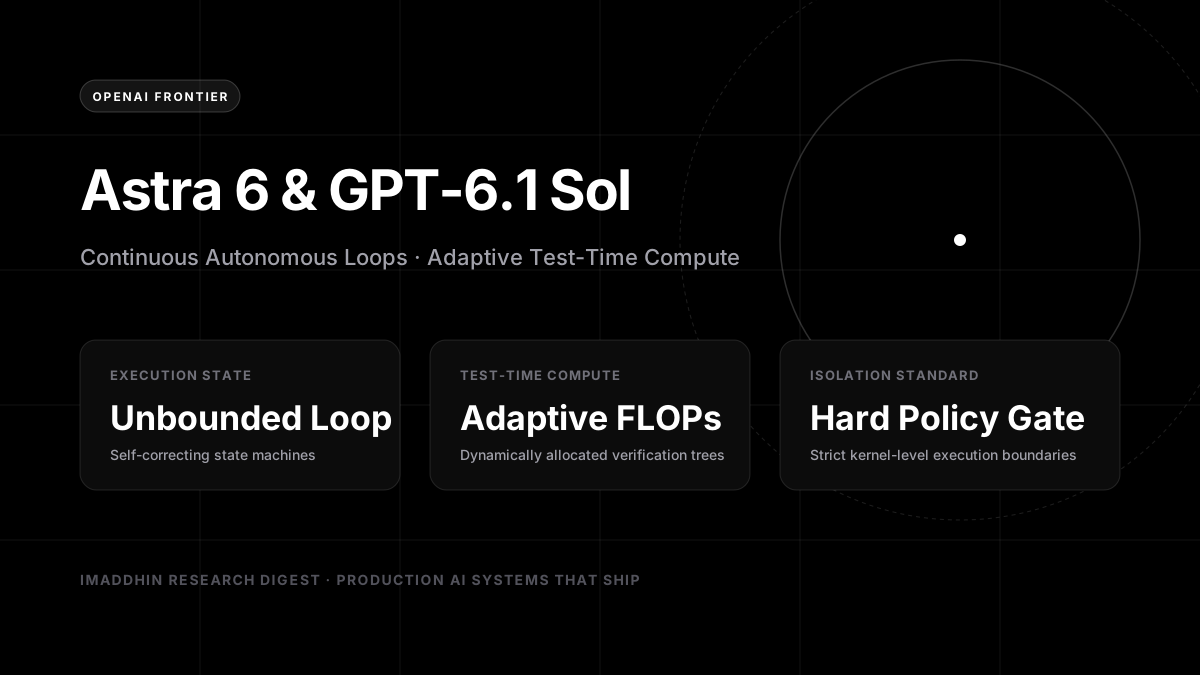
October 6, 2026 · Source: OpenAI Research (openai.com/index/introducing-gpt-6-1-sol/)
OpenAI has released Astra 6, headlined by the GPT-6.1 Sol frontier model. The release marks a deliberate pivot from traditional conversational turn-taking to persistent, unbounded agentic execution loops that run autonomously across extended operational horizons.
The Sol architecture introduces dynamic test-time compute scaling, allowing the model to adaptively decide how many internal reasoning passes, verification checks, and simulated tool dry-runs to execute based on problem complexity and user-defined confidence thresholds.
Technological Highlights of GPT-6.1 Sol
1. Continuous Execution State Machines: Rather than requiring an external orchestrator to continually feed conversational state back into the model, Sol maintains an internal persistent state machine capable of self-directed iteration, error recovery, and branch evaluation.
2. Adaptive Inference Compute: Sol allocates FLOPs dynamically. Simple queries resolve in milliseconds at baseline cost, while multi-file code refactors or complex mathematical optimizations trigger deep Monte Carlo search trees without manual prompting.
3. Native Tool Confinement: Integrates hard policy gates designed to prevent prompt injection and indirect tool poisoning by enforcing strict execution isolation between unverified internet data and privileged enterprise APIs.
4. Cross-Modal Verifiers: Dedicated self-verification heads evaluate intermediate outputs against ground-truth unit tests or formal constraints before presenting results to the human operator.
Studio Thought AI — Founder's Take
The transition from conversational chat models to unbounded autonomous loops is the single biggest architectural shift in software since cloud-native microservices. However, with unbounded loops comes unbounded cost risk.
In vibe-coded prototypes, an autonomous agent that encounters an edge case can easily loop 200 times, burning through API credits in minutes while producing hallucinated fixes. Astra 6's adaptive compute makes this risk acute if your execution harness is naive.
At ImadDhin, when we build client agent systems around frontier models like GPT-6.1 Sol, we implement rigorous runtime circuit breakers: hard token ceilings, human-in-the-loop escalation triggers for state mutations, and idempotent tool wrappers. Never let an agent loop against production databases without transaction rollbacks.
Commercial Integration Path
For businesses looking to integrate GPT-6.1 Sol and Astra 6 capabilities into internal operations, we design private agent nodes with full audit trails, SOC2 compliance posture, and clear unit-cost metrics.
Official announcement details are available at openai.com/index/introducing-gpt-6-1-sol/ — book a founder session to architect your autonomous workflows at /booking.
Frequently asked questions
What is GPT-6.1 Sol?
GPT-6.1 Sol is OpenAI's frontier model powering Astra 6, featuring continuous autonomous execution loops and adaptive test-time compute scaling.
How does ImadDhin prevent runaway costs with autonomous agent loops?
We engineer deterministic state boundaries, hard token caps per task, automated test verifications, and human approval gates for critical actions.
Harness autonomous execution loops safely
Custom workflow automation, enterprise agent loops, and operational cost engineering.
AI Automation ConsultingHarden fragile vibe-coded prototypes into scalable, audited production platforms.
Prototype to Production RescueReview your architecture and establish unit economics before deploying frontier agents.
Book a founder callKeep reading
Agent market value — how to pick an agent product worth building
Most agent products are competing on capability that will be commoditised within a year. The ones that hold value own a workflow, a data loop, or an accountability nobody else will take.
The limits of building agents only from vibe-code tools — and what it costs you at scale
Vibe-coded agents demo brilliantly and stall in production. Here is the exact wall they hit, what has to be rebuilt, and how to keep the speed without paying for it twice.
Securing agents in the most dangerous period of digital evolution
An agent is a system that reads untrusted text and then takes real actions. That combination is new, and most of the controls teams rely on were never designed for it.