

Cloudflare's new Workers AI decision models, October 2026
Cloudflare shipped Clef and Clef-flash on 1 October 2026, then Clef-omni on 9 October. They score an allowed answer instead of writing free text. Here is the family, the price, and where it fits a production agent.
19 October 2026 · Sources: Clef, 1 October, Clef-omni, 9 October, Workers AI changelog
Cloudflare Workers AI now hosts three of its own decision models, Clef, Clef-flash and Clef-omni. They read a state and a list of allowed answers, then return a probability for each answer. There is no paragraph to parse and no reasoning token to wait on.
What is a decision model?
A chat model writes the next token until it decides to stop. A decision model, as Cloudflare describes Clef, does not write. It scores every allowed option in one pass. The caller already decided the legal answers: route this ticket, block this request, escalate to a person. The model only picks among those answers.
Cloudflare trained Clef on a Qwen backbone and hosts it on Workers AI. Clef and Clef-flash shipped on 1 October 2026 under an Apache 2.0 license on Hugging Face. Clef-omni followed on 9 October 2026 and joins them as an open-weight model in the same family. The API is compatible with Typesafe's Jev, so a caller that already speaks that decision API can point at the Cloudflare model id.
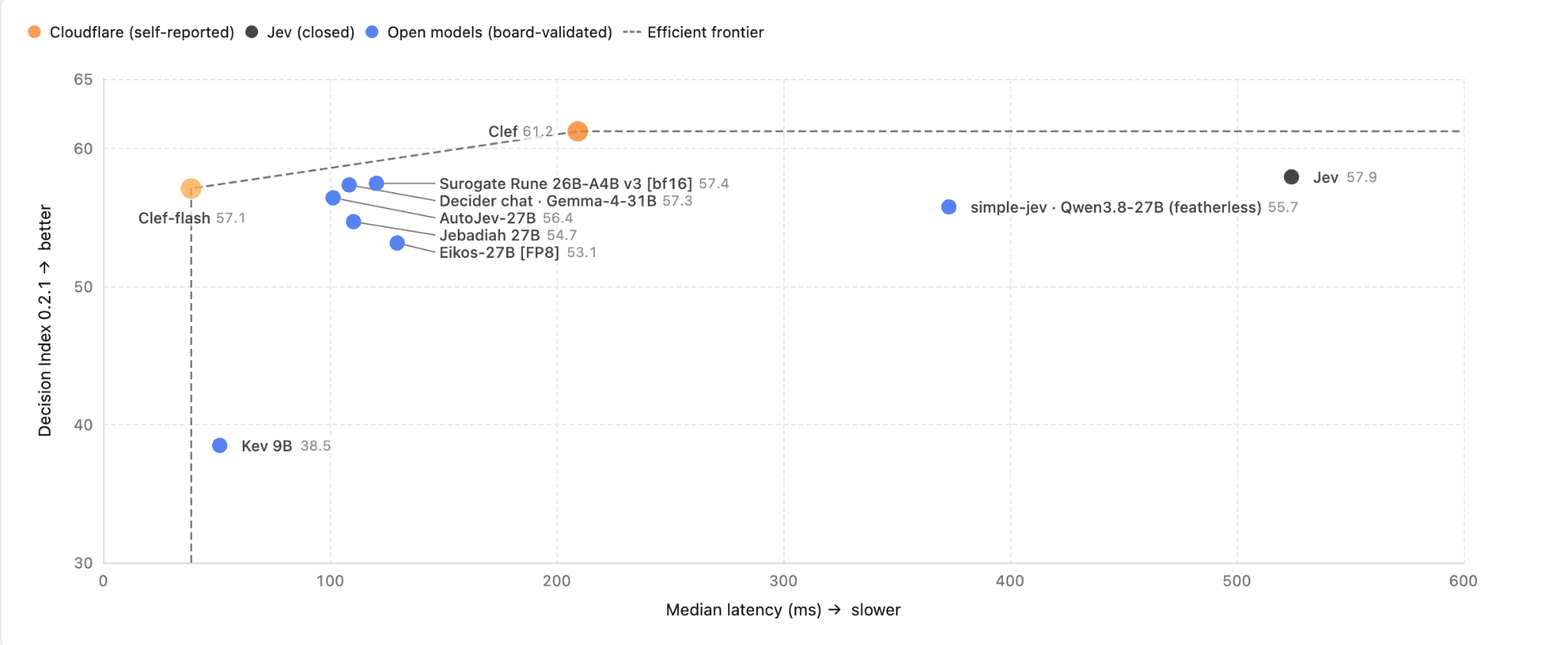
The chart in this post is Cloudflare's own Decision Index 0.2.1 plot from the 1 October announcement. On that chart Cloudflare places Clef at 61.2 and Clef-flash at 57.1, against a Jev point at 57.9. Those are Cloudflare's reported figures, not a benchmark we ran.
Which model does which job?
Figures below are what Cloudflare published on 1 October and updated on 9 October 2026. Hosted prices and context windows move. Check the Workers AI models page before you commit a budget.
| Model | Size | Hosted price | Context | Use it when |
|---|---|---|---|---|
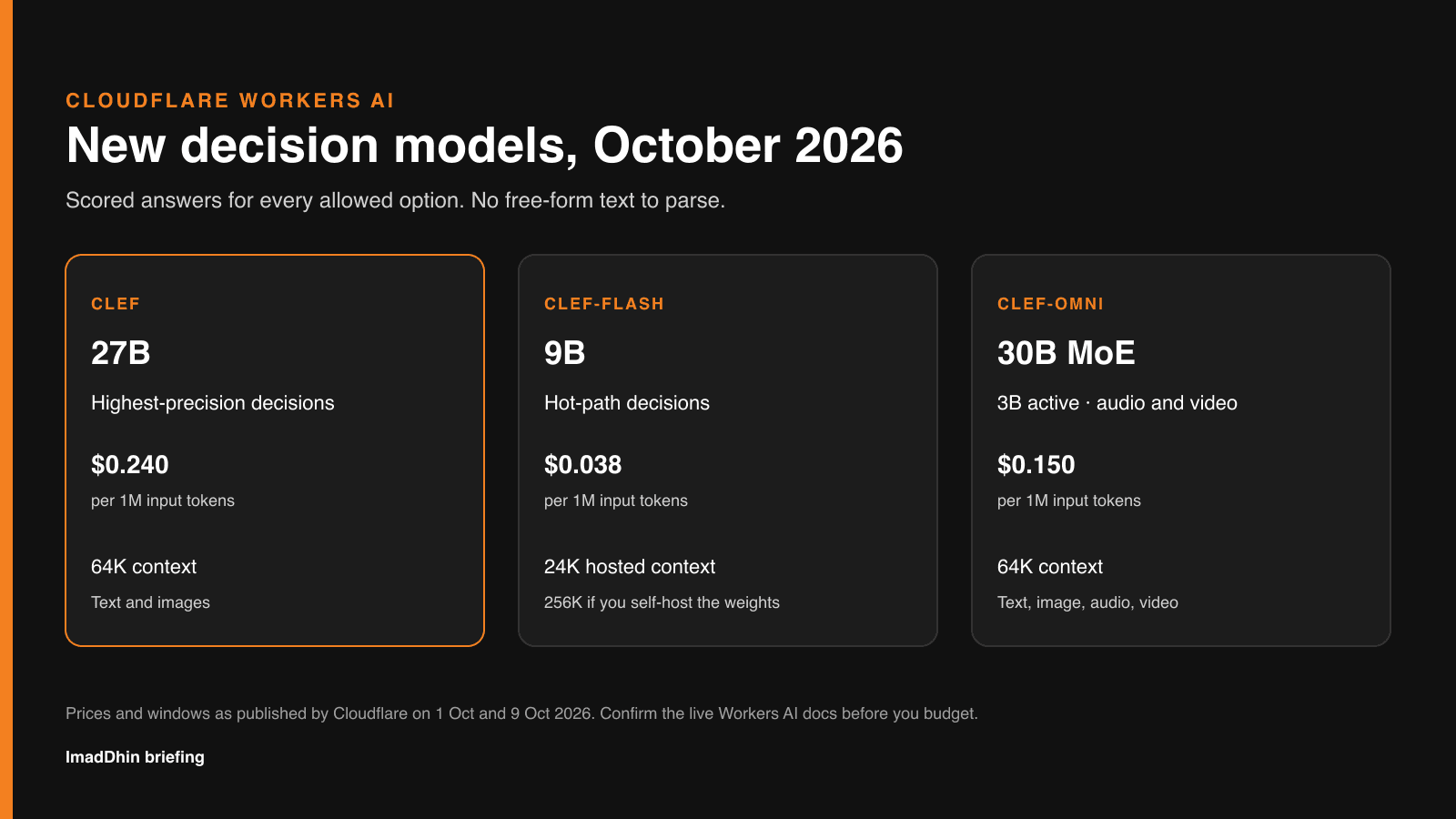
| @cf/cloudflare/clef | 27B | $0.240 per 1M input tokens | 64K | The decision has to be the most precise one in the family. |
| @cf/cloudflare/clef-flash | 9B | $0.038 per 1M input tokens | 24K hosted | The decision sits on a hot path and the input is small. |
| @cf/cloudflare/clef-omni | 30B MoE, 3B active | $0.150 per 1M input tokens | 64K | The input is audio, video, an image, or a mix. |
Clef-flash launched with a 64K hosted window. On 9 October Cloudflare cut the hosted window to 24K so it could cut the price from $0.090 to $0.038 per million input tokens, which Cloudflare says is below Jev. Cloudflare also says 0.24% of observed requests were over 24K tokens. The Hugging Face weights were not changed and still support a 256K window if you host them yourself. If your state does not fit in 24K, use Clef, which kept the 64K hosted window at $0.240.
What does Clef-omni add?
Before Clef-omni, a decision about a recording meant a chain: transcribe, split the tracks, then ask a text model. Clef-omni takes WAV or MP3 audio and MP4 or WebM video in the same request as text and images. Cloudflare says the soundtrack stays aligned with the frames, so the score can use what is seen and what is heard together.
Cloudflare's reported times, from the Workers AI changelog, are about 20 ms for text, under 100 ms for an image or audio input, and about 300 ms for a 21-second video clip with sound. Treat those as vendor measurements of their hosted path. Your own p95 depends on the payload and the colo.
On the same changelog, Clef-omni's case-exact BFCL score is 98.2, next to Clef at 98.47 and Clef-flash at 98.76. PhishNChips accuracy is higher for Clef (79.60) than for Clef-omni (73.2). Multimodal input is not automatically the better classifier. Pick omni when the evidence is a recording. Pick Clef when the evidence is text and the cost of a wrong class is high.
Where does this sit next to a chat model?
Keep the chat model for language a person will read: a summary, a draft, an explanation. Put the decision model in front of the tool call. Cloudflare's own examples are support triage, domain classification, a trust-and-safety rubric, and an agent asking "should I take this action?" before it calls a tool.
That last one is the production pattern. The agent may be a long-context coder. The allow, block or escalate step should be a scored answer with a schema you wrote, fast enough to run on every call. A decision model does not replace authorization in your application. A high score for "allow" is not proof the caller owns the record. Pair it with the checks in the agent permissions guide.
Cloudflare also says Workers AI does not train on customer content, and that standard inference is not retained after the response, with the exceptions they list for logging, storage and fine-tuning. Read the current data usage page before you send customer content. The reinforcement-learning fine-tune for Clef was announced as a design-partner program, not as a switch you can assume is open on every account.
If you want a decision step like this inside an agent that already does a real job, that is Agent Production. Book a 30-minute call and bring the decision you want scored, the answers you will allow, and the system that must still enforce the result.


Frequently asked questions
Do these models write replies?
No. Cloudflare's Clef family returns a probability for each allowed answer. A chat model still writes anything a person will read.
Which hosted context window is current?
As of Cloudflare's 9 October 2026 post, Clef and Clef-omni are 64K. Hosted Clef-flash is 24K. The Clef-flash weights on Hugging Face still support 256K if you self-host them.
Are the prices fixed?
No. The figures in this post are what Cloudflare published on 1 October and 9 October 2026. Confirm the live Workers AI model page before you budget.
Can Clef authorize a user?
No. It can score a policy question you defined. Ownership and permission still have to be enforced where the action runs.
Put a scored decision in front of the tool call
Bring the decision, the allowed answers, and the system of record.
Book a 30-minute callProduction agents with a permission boundary on every tool.
AI agents practiceA custom agent fitted to one job in your business.
Agent ProductionKeep reading
Agent Production: a custom AI agent that fits your business
Agent Production is the next offer for anyone who wants a custom AI agent in their business or their own case. One job, your systems, your industry rules, and a studio that stays after launch.
AI agent permissions, tool scopes and audit trails
An agent's blast radius is the sum of everything it is allowed to call. Here is how to scope permissions per tool, keep credentials narrow and short-lived, and record an audit trail that answers who asked, what ran, and what changed.
Cloudflare Application Profiles: securing existing applications
What Cloudflare Application Profiles add to request protection—and the authorization, payment checks and rollout tests your application still needs.