

11 min read
From LLMs to secure autonomous agents: building the next wave of enterprise and Sovereign AI
GTC Berlin 2026 reframed software around AI factories, Sovereign AI, agent harnesses, and Physical AI. Here is the stack that matters for production Super Agents, and how to ship secure custom agents on your data.

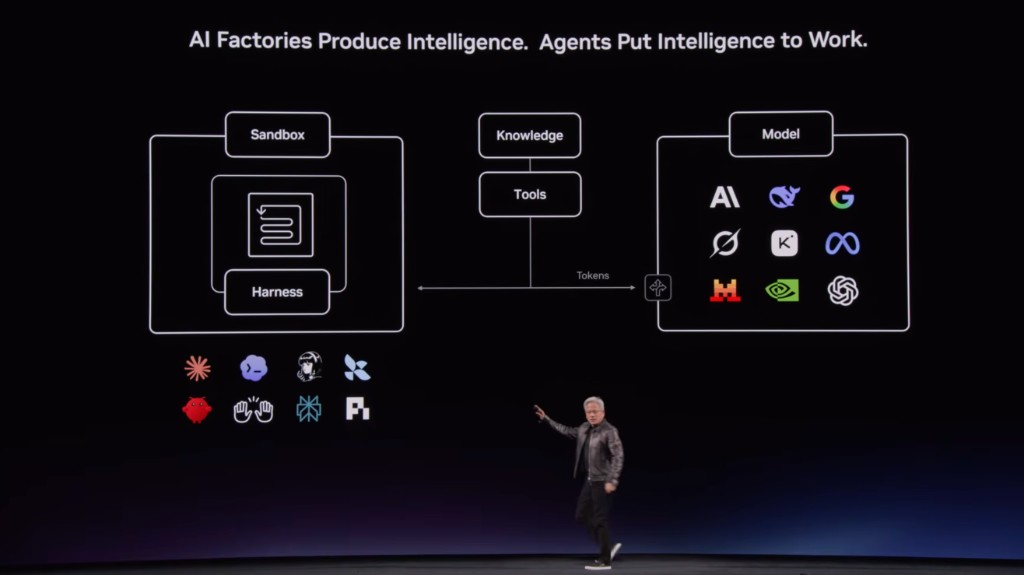
Secure autonomous AI agents are no longer a chat feature bolted onto an app. At the NVIDIA GTC Berlin 2026 keynote, Jensen Huang described a stack where AI factories produce tokens, Sovereign AI owns domain intelligence, and production Super Agents need a model, harness, sandbox, knowledge, and tools with security enforced outside the model.
22 October 2026 · Sources: NVIDIA GTC Berlin 2026 keynote; NVIDIA platform pages for Vera Rubin, OpenShell, and Nemotron. Timestamp references below point into that keynote. Claims about hardware multipliers and product names are attributed to the keynote and NVIDIA materials, not invented studio metrics.
What did GTC Berlin 2026 change for builders?
The useful shift is from consuming a generic public model to producing custom, secure agents that own your domain work. Huang framed the industry around AI infrastructure, Sovereign AI, AI safety, and Physical AI. For startups and enterprises, that means treating intelligence as something you manufacture and operate, not only rent by the prompt.
If you already ship AI agents or AI product engineering, the keynote is a checklist for the next layer: durable harnesses, sandboxed runtimes, proprietary knowledge, and least-privilege tools. It is not a reason to rebuild a working product around a slide.
What is an AI factory in the five-layer stack?
An AI factory is infrastructure whose primary output is tokens: the units of digital intelligence that turn data into actions. Huang described a five-layer cake: energy; advanced computing systems such as the Vera Rubin generation and Spectrum-X optics; turnkey AI factories and reference deployments such as the DSX Pod; foundation and specialized models across language, biology, physics, and robotics; and AI-native applications where users meet the intelligence.
Your product still sits at the top of that stack. Cloud-native web apps and mobile clients consume high-velocity tokens to solve business logic. The factory layer matters when you are choosing private capacity, time-to-first-token for a private cluster, or a path from local prototype to cloud burst. For most software teams, the immediate job is still the application and agent layer, with infrastructure chosen to match workload and data residency.
What are the five core elements of a production Super Agent?
A production Super Agent is an autonomous system that perceives, reasons, plans, iterates, and executes with explicit boundaries. Building one is orchestration of five parts, not a single model call.
- The model (the brain). Perception, reasoning, and planning. Production stacks usually combine frontier closed models with customized open-weight models rather than depending on one monolith.
- The agent harness (the exoskeleton). Orchestrators such as LangChain, Hermes, OpenClaw, or a custom runtime that manage working memory, long-term memory, and sub-agent coordination. Framework choice should follow failure modes; see AI agent frameworks in 2026.
- The secure sandbox (the runtime). Isolation so the harness can execute code and workflows without unrestricted host or network access.
- The knowledge foundation (proprietary context). Structured SQL and unstructured documents become operational intelligence through parse, embed, and rerank pipelines plus vector search. Memory design is covered in what to store in agent memory and RAG.
- Accelerated tools (the hands). APIs, compilers, domain solvers, and simulators the agent is allowed to call. An agent is only as useful as the tools it can operate under policy.
How do Super Agents differ from a chatbot wrapper?
| Chatbot wrapper | Production Super Agent | |
|---|---|---|
| Loop | One prompt, one reply | Plan, tool use, iterate, resume |
| Memory | Session chat history | Working memory plus durable domain knowledge |
| Tools | Optional plugins | Allowlisted tools with typed inputs |
| Security | Prompt instructions | Sandbox, credentials outside the model, runtime policy |
| Records | Vendor chat log | Your run ledger, approvals, and audit trail |
How does Sovereign AI turn proprietary data into a moat?
Sovereign AI means owning the intelligence that runs on your workflows instead of renting every capability from a generic public endpoint. When legal compliance, specialized domain knowledge, or proprietary customer data are in play, a general model is rarely enough.
A practical path is to start from transparent open-weight foundation models, such as NVIDIA Nemotron where it fits the stack, then post-train or fine-tune on organization data under your governance. The goal is agents that outperform a generic frontier model on your specific tasks while keeping data residency and access control under your control. That is the same posture we take on enterprise AI agents for clients who cannot put their system of record in a public chat window.
Why is hope not an AI security strategy?
When agents get access to internal networks, databases, and code repositories, prompt-level guardrails are not engineering. Asking a model not to delete a database or leak an SSH key is not a control plane.
Agent-native security enforces permissions outside the model. Huang highlighted isolated sandboxes and policy enforcement with platforms such as NVIDIA OpenShell, zero-trust credential handling where secrets stay with a supervisor and are never held inside the agent sandbox, and hardware-isolated monitoring such as NVIDIA Sentry on BlueField-4 for real-time quarantine of rogue behavior. The principle for client work is the same: least privilege at the tool boundary, approvals for consequential writes, and runtime evidence operators can read. Pair that with the AI agent permissions and audit trails pattern and human-in-the-loop gates.
What does Physical AI change for product teams?
Physical AI is intelligence that understands physics, space, and real environments: fleets, factories, telecom networks, and robots. Simulation and world models, including stacks in the Omniverse and Cosmos family, sit next to agent harnesses that can burst from a local workstation to the cloud and then deploy validated policies to edge devices.
Most ImadDhin clients will not start with a humanoid. They will start with agents that already touch calendars, catalogues, bookings, and messaging, then extend into vision, robotics interfaces, or edge inference when the business has a physical loop to close. Portfolio work such as TownSquare AI, RiseRight, and mobile products on FlutterFlow still ships through the same production bar: one job, real systems, and approvals where customers feel the result.
What should you build first after this keynote?
Name one expensive failure in your workflow: a crashed long run, an unapproved write, a knowledge gap, or a missing audit trail. Then design the smallest Super Agent that prevents that failure: one model path, one harness, one sandbox policy, one knowledge source, and a short allowlist of tools. Keep the evaluation set as real cases from your week. If a simpler automation or a SaaS assistant already does the job, use that instead.
Huang’s line from Berlin is the industry direction: tools companies become agents companies. The studio work is turning that direction into production software with clear cost ceilings and security that does not depend on a polite prompt.
If you want a custom autonomous agent, a Sovereign AI path on your data, or a sandboxed RAG foundation scoped to your systems, book a 30-minute call or start a brief on /start.


Frequently asked questions
What is a Super Agent?
A production Super Agent is an autonomous system with a model, harness, secure sandbox, proprietary knowledge, and allowlisted tools. It plans and acts with records and permissions outside the chat transcript.
What is Sovereign AI for an enterprise?
Sovereign AI means the intelligence that runs on your workflows is trained or post-trained under your governance, with data residency and access control you control, instead of depending only on a generic public endpoint.
Is prompt guardrailing enough for agent security?
No. Agent-native security needs sandbox isolation, credentials kept outside the agent, least-privilege tools, and runtime policy enforcement. Prompts help behavior; they do not replace a control plane.
Do I need an AI factory before I can ship an agent?
Usually not. Most teams should ship the application and agent layer first, then choose private capacity or reference factories when latency, residency, or scale demand it.
How does this relate to ImadDhin Agent Production?
Agent Production fits a custom agent to one real job on your systems with approvals for consequential actions. This article is the industry stack behind that offer; the engagement is scoped on a call or brief.
Build a secure agent on your stack
Scope one job, your systems, and the security boundary before you pick a model.
Book a 30-minute callDurable runs, sandboxed tools, RAG knowledge, and production handoff.
See AI agent developmentSend the workflow and constraints; we reply with a concrete next step.
Start a project briefKeep reading
AI agent frameworks in 2026: what changed and how to choose
Agent framework updates in 2026 made the major options look alike on paper. The useful difference is how each one handles crashes, approvals, runaway loops, untrusted tools, and vendor change.
Human-in-the-loop AI agents: approval steps that don't kill the return on investment
Approval steps protect trust in an agent, but applied to everything they erase the time it was meant to save. Here is how to gate only the actions that need a person, and how to design the approval itself.
Agent memory and RAG development: what to store, what to forget
Most agent memory problems are storage decisions made by default. Here is how to decide what an agent should remember, where each kind of memory belongs, and when retrieval is not needed at all.
AI agent permissions, tool scopes and audit trails
An agent's blast radius is the sum of everything it is allowed to call. Here is how to scope permissions per tool, keep credentials narrow and short-lived, and record an audit trail that answers who asked, what ran, and what changed.
Agent Production: a custom AI agent that fits your business
Agent Production is the next offer for anyone who wants a custom AI agent in their business or their own case. One job, your systems, your industry rules, and a studio that stays after launch.